Technology/Our technology
The technologies behind our solutions
The technologies that shape our business solutions
Each one ships on its own, and combines with the others when you decide
Content operations
The operations engine analyses a repository, transforms, then moves at scale. Documents, versions, metadata and rights follow, in controlled batches.
The repository and workflows
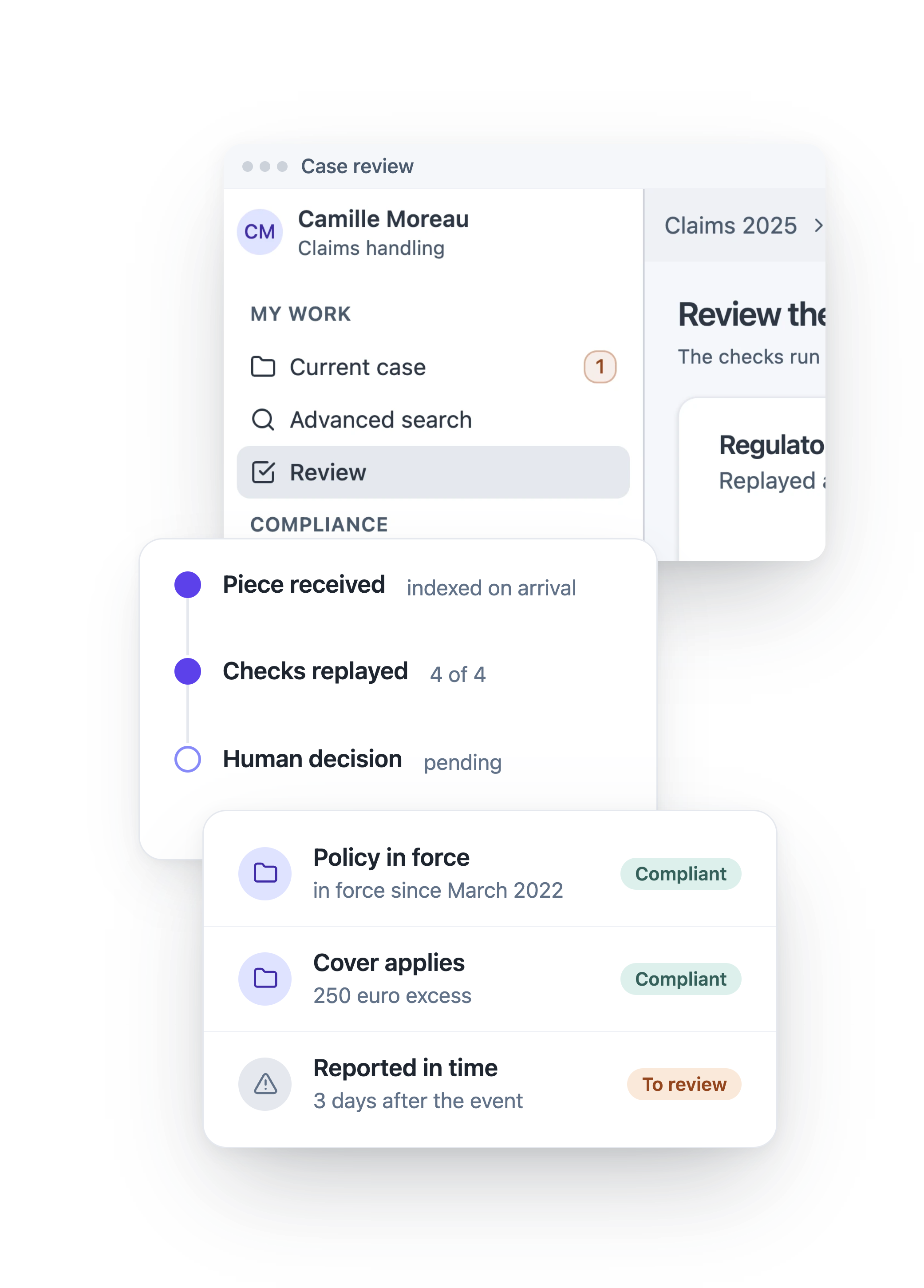
It stores content and business objects in a flexible model, then moves cases forward along processes you change without rebuilding the application.
Rendition and collaboration
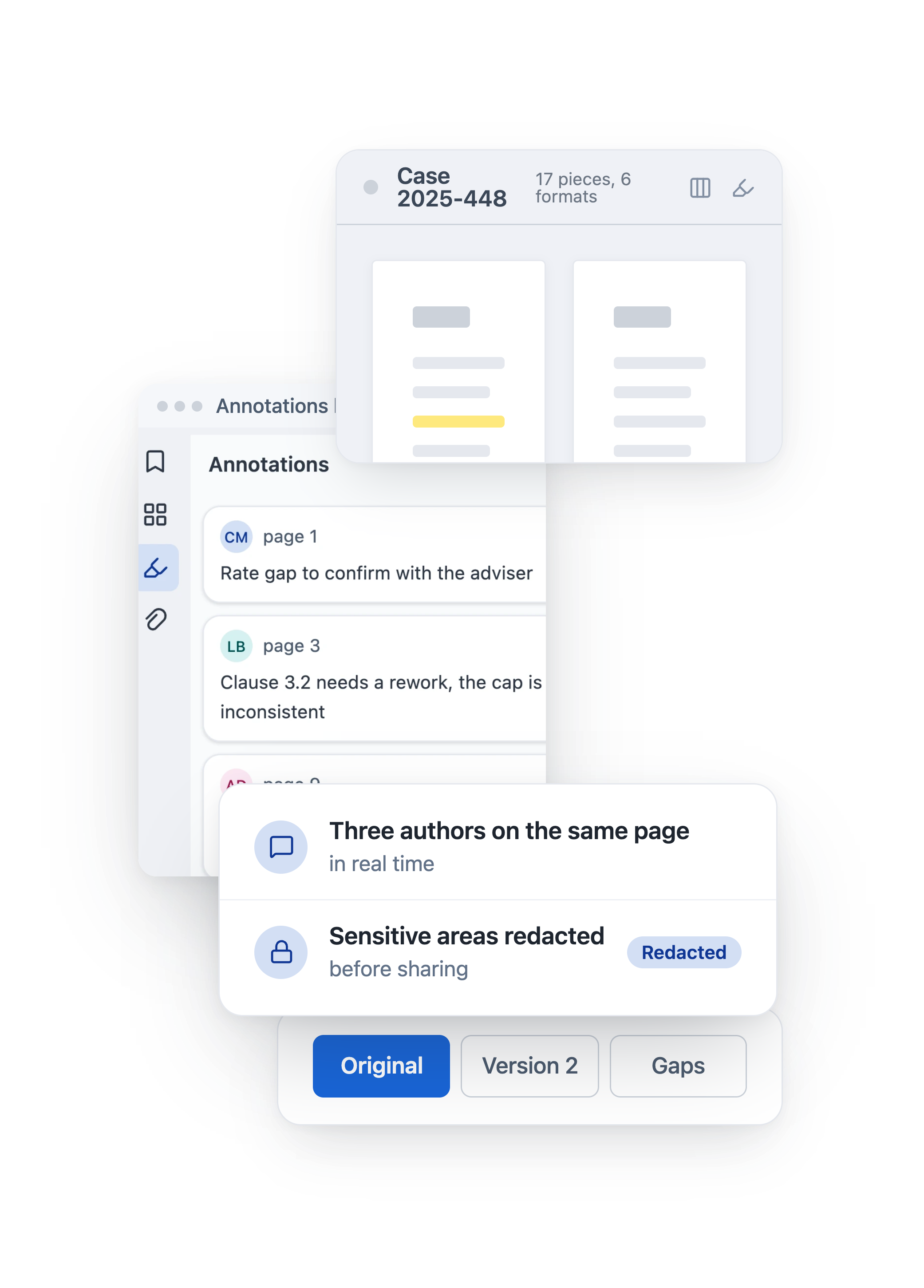
It turns more than 200 formats into a readable view in the browser, with no download and no local copy, and carries annotation, comparison and redaction.
Artificial intelligence
It reads, classifies, extracts, summarises, compares and checks, inside the case and the process already in place. You call it like the rest, by API.
The rest of the page takes them one at a time, with what each one does.
A solution is technologies put together
This page describes those technologies: what they do, how you call them, and where they run.
What it commits to
complementary approach
The operations engine is enough to run a migration. The viewer is enough to modernise a business application. Nothing forces you to take the rest.
by design
There is no function you can only reach from our screens. What the interface does, a call does too, with the same rights.
your rules
The same software runs on site, in your private cloud or as SaaS. You choose the setup at the start, and you can change it along the way.
without destroying
The technologies add to your content foundation and your business applications, with no obsession about removing everything.
One technology first, the scope after
What happens today
A content overhaul almost always shows up as one big thing: a foundation to replace, an eighteen month project, a big-bang cutover one weekend. That is what makes people step back, and it is rarely necessary.
What changes
A technology ships on its own, on the scope you pick. The content operations engine runs a migration without the repository moving. The viewer opens inside the application you already have. The AI capabilities plug into what is running.
Together they cover the full cycle, from preparing content to putting it to work. Separately, each one stands up. It is the same thing seen from two sides.

Artificial intelligence put to work in your business
They are called where the work happens: in the open case, in the process step, in the document on screen
Read and extract
The useful fields come out of the document and fill the case: numbers, amounts, dates, clauses, parties. The handler checks, they do not retype.
Classify and file
Every piece gets its type, its language and its metadata on arrival. A poorly qualified estate comes back into order without manual entry.
Summarise a case
A three hundred page case reads in ten lines, with a link to the piece and the page each statement comes from.
Compare two versions
Two versions of a contract, an endorsement against its policy, a piece against the rule: the gaps show instead of being hunted.
Check consistency
Consistency between pieces is verified, and what is missing is said before the case moves to the next step.
Search and answer
Search works on meaning, not on the exact word. A question in plain language finds its answer in the content you are entitled to see.
The frame that holds AI in a regulated environment
The guardrails, because an answer with no trace does not pass an audit
- Full logging Every call keeps its question, its answer, its model and its timestamp. A check replays months later.
- Human validation A threshold decides what goes to validation. Below it, nobody signs in the handler’s place.
- Cited sources An answer points to the piece and the page it comes from. Without that address, it is not usable in a case.
- Rights respected The AI only reads what the user is allowed to read. The permissions of the foundation apply before the call, not after.
- Model choice The model is chosen by use, and it can be changed. One model hosted at your site for sensitive content, another elsewhere for the rest.
- Measured cost Consumption is tracked by use and by service. A capability that costs more than it returns shows up straight away.
An AI you cannot explain costs more than a failed project: those are decisions taken on answers nobody can justify.
The NoSQL repository and workflow orchestration
Flexible content model
A document type is created and changed with no schema migration. NoSQL storage accepts objects that do not look alike.
Volume and response time
The repository is built for hundreds of millions of objects, with a response time that does not degrade as the stock grows.
Flexible deployment
The repository installs on site, in a private cloud or in a public cloud, according to what your rules require. The choice is made at the start, and it is not final.
Workflow orchestration
Processes are described, versioned and changed without redeploying the application. An added step is not a project.
What it changes
The case becomes the object of work, not the isolated document. A process step is added without redeploying the application.
- Rights, retention, audit trail Permissions go all the way down to the piece. Every action is timestamped, and the audit trail reads without being pieced back together.
- Search and indexing Content and metadata are indexed on write. Search crosses the two, and it respects the rights of whoever runs it.
- Versions and lifecycle A piece keeps its versions, its dates and its final fate. Archiving and purging follow the rule, not a handler’s memory.
Rendition for collaboration
Conversion API
Convert documents to more than 200 formats, with full compatibility and accessibility.
Transformation API
Change content on the fly: sign, redact, watermark, merge, export, split or enrich.
Image generation API
Pull out pages or regions as images, for a dashboard, a workflow or a visual inspection.
Document layout API
Set the page structure, the content placement and the display rules, to control exactly how a document appears.
What it changes
The user no longer leaves their application to read a piece, and the file never lands on their machine.
- Redaction and security Sensitive areas are hidden before sharing, and the mask travels with the export. The rights of the foundation apply to the view.
- Embedded in your screens The viewer sits inside a business application, a portal or an ECM, by API and by web components.
- Heavy documents A thousand page case opens on the first page, page by page. Display time does not depend on the weight of the file.
The content operations engine
Repository analysis
It inventories what the source holds before touching anything: types, volumes, duplicates, dead formats, inherited rights, missing metadata.
Transformation
It rewrites metadata, flattens a taxonomy, converts formats and applies your naming rules on the way through.
Recurring injection
Content arrives in the target system in scheduled waves, not in a single cutover one weekend. The flow runs for as long as the source lives.
Auditability
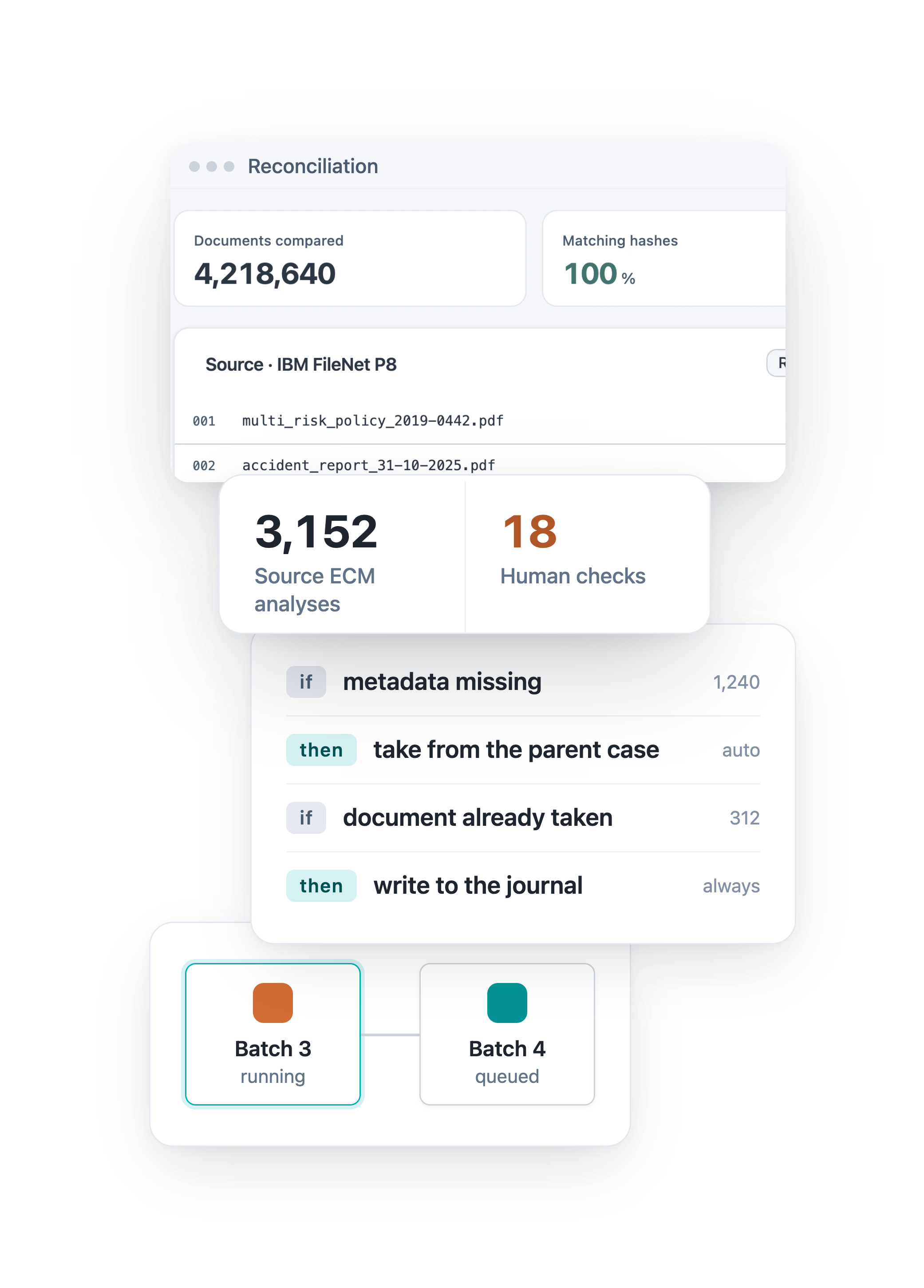
Every wave leaves its trace: what left, what arrived, what was set aside and why. The reports export as they are, in front of an auditor.
What it changes
It works below the floorboards. No business user ever sees it, and it is the one that moves the volumes.
- Business rules Retention, filing and access rules travel with the content. They are not keyed in again in the target.
- Restart and replay A batch that fails picks up where it stopped. Nothing starts from zero, nothing is duplicated.
- Supervision Throughput, errors, delays and remaining volumes read while it runs, not in a report the next day.

What these technologies plug into
What these technologies are used to build
- AI app modernization The AI capabilities enter an existing application, by API, without redoing its interface.AI app modernization
- Accelerated migration The content operations engine empties an end-of-life foundation in batches, with proof of the count at every step.Accelerated migration
- Intelligent case management The repository and the workflows carry the case, the AI capabilities read it and say what is missing.Case management
- Universal intelligent viewer Rendition opens every format inside your screens, and AI works on the page on display.Universal viewer
- Content governance Repository analysis, classification and retention rules bring order back to a scattered estate.Content governance
- Alternative to SharePoint The repository brings Microsoft 365 the content model and the processes it does not have.Alternative to SharePoint