Solutions/Intelligent case management
Intelligent case management: process complex cases without losing control
When a business case arrives, it is never limited to a single document.
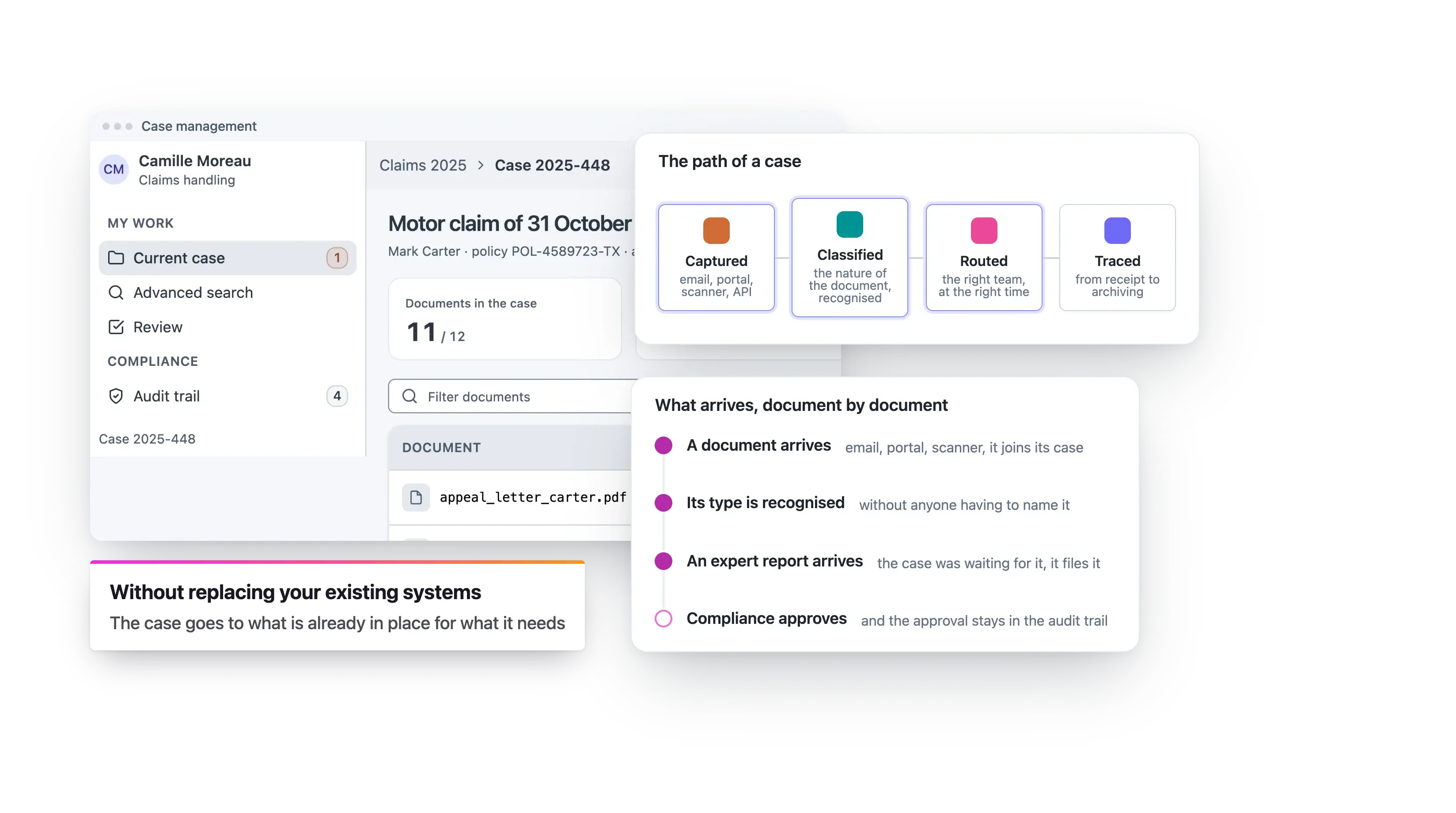
The real problem is not the case itself. It is the information fragmented around it
An insurance claim, loan application, member case, regulatory file or customer case is never difficult simply because of its volume. It becomes difficult because the relevant information is distributed across multiple channels, formats, teams and tools.

What it commits to
- One document arrives by email Another is submitted through a portal, and supporting evidence is scanned.
- An expert report is added later The case had already started running without it.
- A case handler annotates the file A compliance review follows in the same breath.
- A regulatory deadline begins to run And from then on it runs for everyone.
Every stage adds friction
In many organisations, this information remains fragmented across inboxes, document management systems, portals, scanners, business applications and tracking spreadsheets.
- Searching The information has to be found before it can be checked.
- Sorting and comparing Every item is compared with the previous ones, by hand.
- Re-entering The same data is keyed a second time, in another tool.
- Following up The follow-up depends on someone remembering at the right moment.
- Reconstructing context The context of the case is rebuilt by hand, at every stage.
- Escalating The escalation arrives once the deadline has passed, not before.
Uxopian Software brings together content, extracted data, business rules, statuses, annotations, deadlines and processing history within a usable case structure. As cases become more complex, information must become easier to use.

A complete processing chain, from receipt to archiving
Before
After
Emails, web portals, scanners, partner APIs and business applications: cases rarely begin through a single channel. Teams now work from a document base that has already been organised, prioritised and prepared for use.
Classify documents and extract information using AI
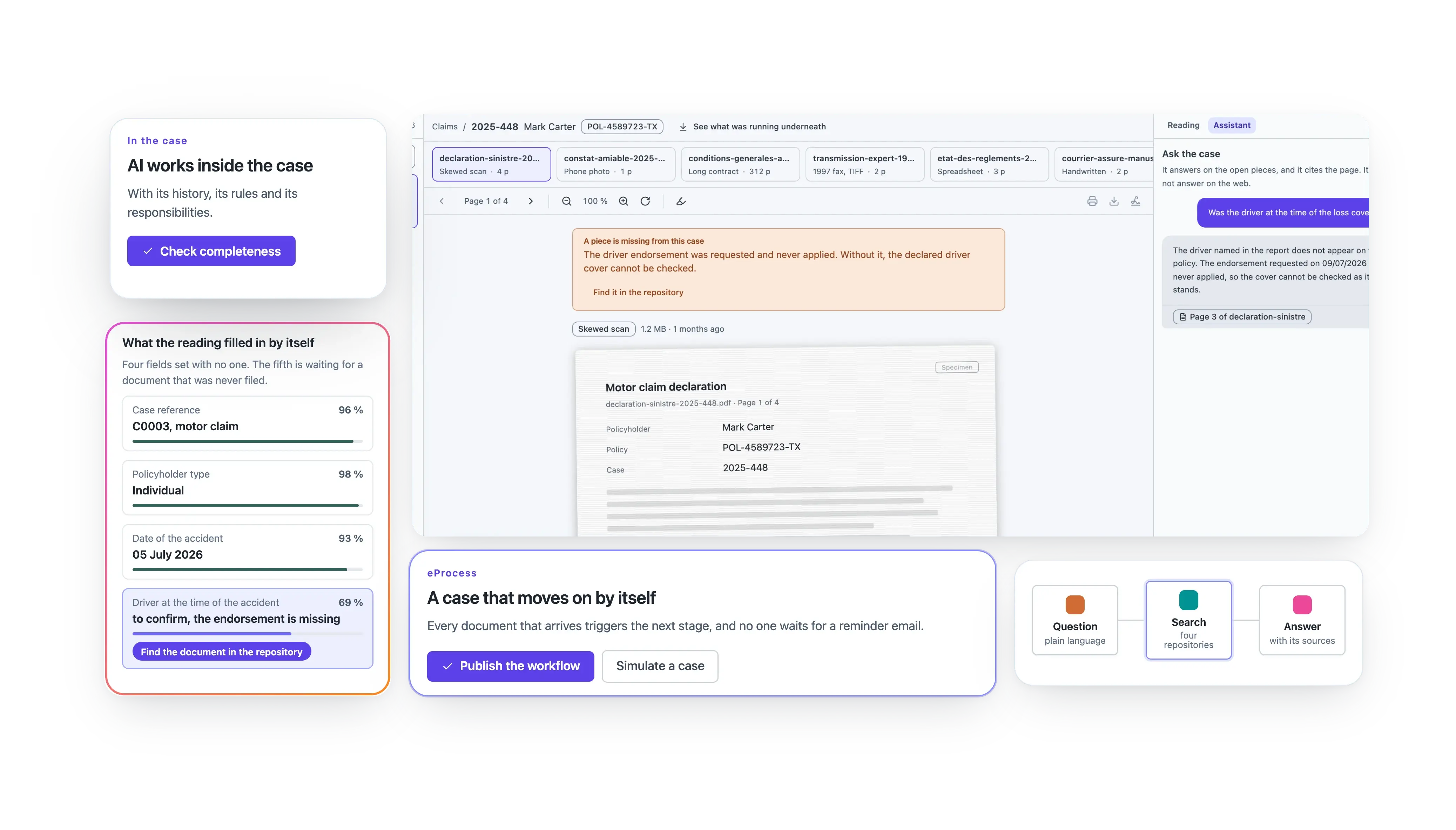
- What type of document is it? Uxopian AI recognises the nature of the document as it arrives.
- Which case does it belong to? The match is made on the content, not on the file name.
- What business information does it contain? The useful data is extracted and made usable.
- What action should follow? A confidence level is assigned to the proposed processing outcome.
- Straightforward cases are accelerated What needs no arbitration moves on without waiting.
- Ambiguous cases are isolated They go to targeted human review, rather than a re-reading of everything.
AI does not operate in isolation. It works within the context of the case, the applicable business rules and the existing process. Case handlers focus their attention on the points that genuinely require their expertise.
Route every case to the right person
Once a case has been classified correctly, it must be assigned to the right team at the right time.
Routing follows your business rules
Case type, document category, priority, geographical area.
Risk and authorisations
Risk level, team availability and authorisations enter the rule.

Delegations, when someone is absent
They trigger automatically, without anyone having to think about it.
Escalations, before the deadline
SLA timers become visible within the process, rather than tracked separately in a spreadsheet.
The case no longer depends on an employee's memory or a manual follow-up. It follows a governed path.
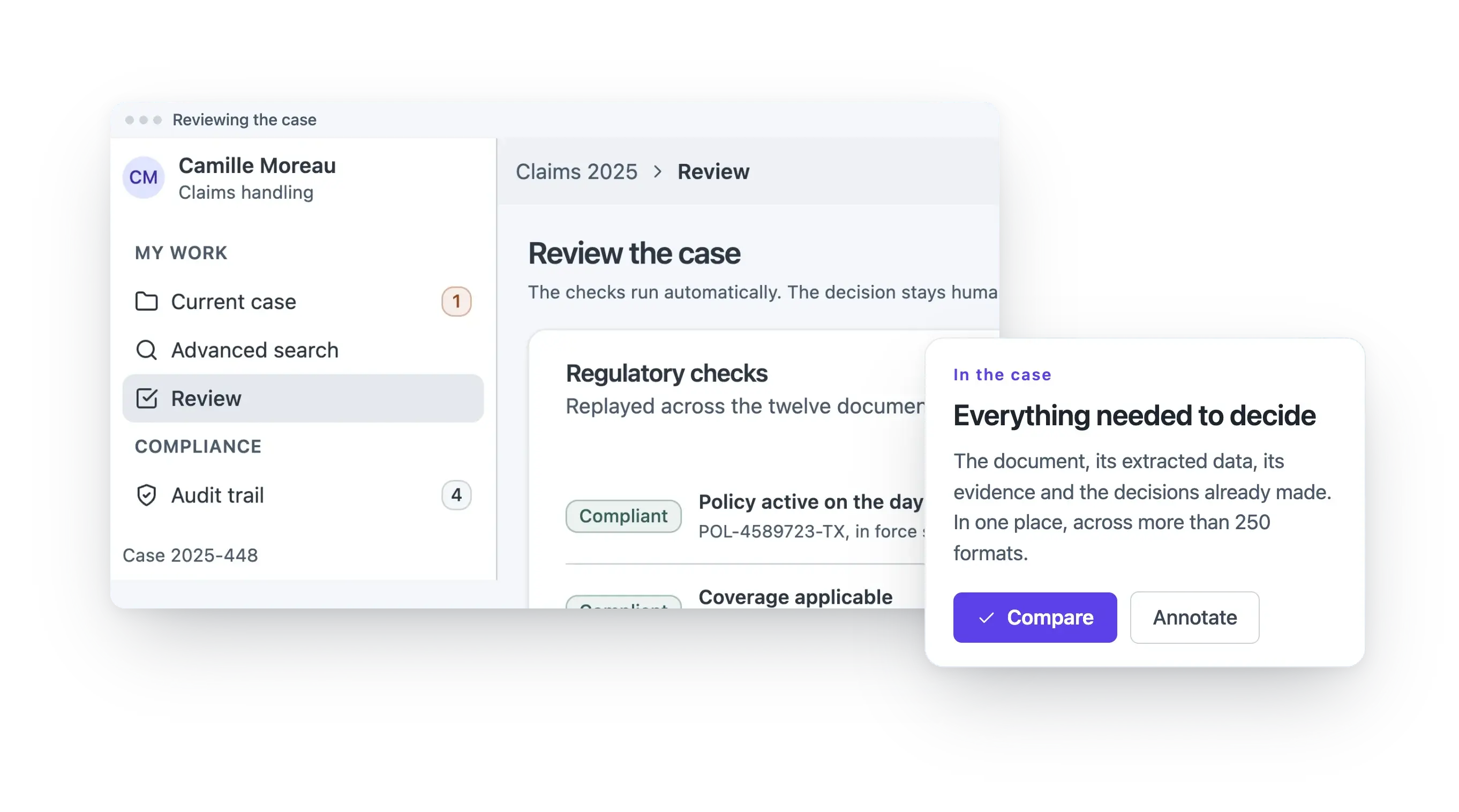
Give case handlers a complete view of the case
To make the right decision, a case handler needs to see more than an isolated document. With ARender and FlowerDocs, content is reviewed in context, directly in the browser, across more than 250 formats, without local downloads or disruption to the user experience. Handlers compare, annotate, verify and decide within a single environment.
The case becomes a working environment, not merely a document repository.
Trace every action through to closure
In a critical case, the final decision is never the only important element. Uxopian Software maintains a complete audit trail throughout the case lifecycle, from receipt to archiving.
Compliance no longer depends on reconstructing events manually after the fact. It becomes an inherent property of the process.

AI accelerates processing, but decisions must remain controlled
What AI can do
Classification, extraction, summarisation, anomaly detection, document matching, prioritisation, routing recommendations and review assistance.
What it cannot become
In critical processes, it cannot become a black box. Confidence levels, human validation, access rights and intervention records remain visible.
What teams know
What the AI proposed, why a review is required, who confirmed or corrected the analysis. Automation accelerates processing, while the organisation retains control over its processes, data and decisions.
Human oversight, auditability and regulatory requirements
In regulated environments, using AI within business processes cannot be justified solely by productivity gains.
- Oversight Human reviews are triggered according to confidence level and document type.
- Operational explainability Every intervention is recorded, and every correction stays associated with its context.
- Traceability Every stage can be linked to the case lifecycle.
- Access control Who sees what, and who can decide what, stays defined by your rules.
- Documentation The means to document your use of AI are in the product, not beside it.
- Risk level The nature of the decision required sets the level of review.
The objective is not to promise compliance in the abstract. It is to give organisations the technical and operational means to document, control and audit their use of AI within document processes.
Modernise your processes without replacing critical systems
Intelligent case management should not become an unmanageable transformation programme.

What already works stays in place
In large organisations, document processes already depend on document management systems, ECM platforms, business applications, repositories, directories, access rules and certified architectures. Replacing them abruptly is neither simple nor always necessary. A certified architecture is not replayed, and a repository holding years of content is not emptied overnight.
The approach is progressive
Connect, enrich, automate and govern what already exists rather than starting again from scratch. Capabilities are then extended in line with your operational constraints, at your pace. You move scope by scope, and each scope proves the next. Modernisation becomes safer because it respects what already works.

Connect, enrich, automate and govern what already exists
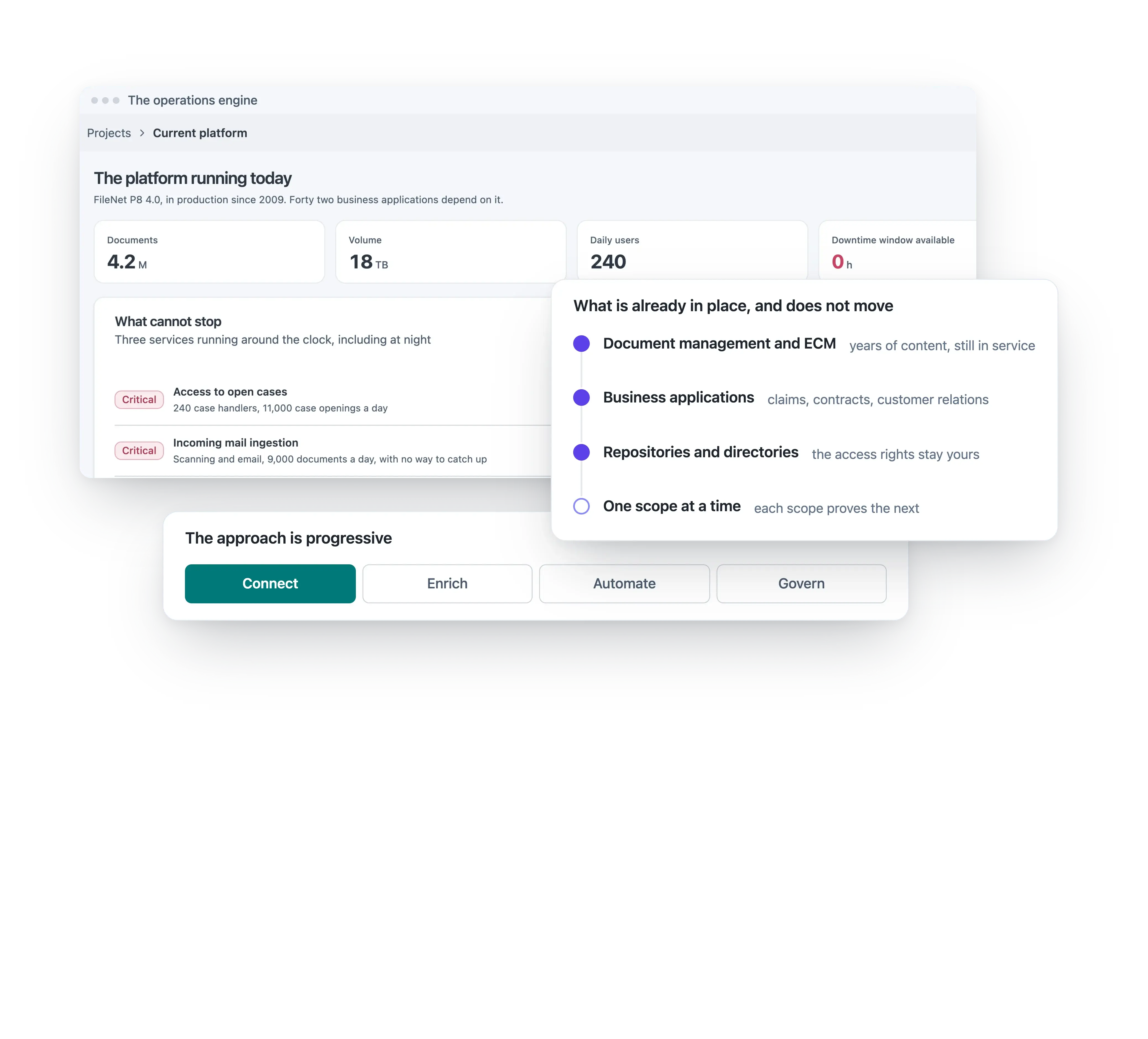
Uxopian Software takes a progressive approach. You keep your repositories and your access rules.
- Connect The systems in place stay there, and the case goes to them for what it needs.
- Enrich Extracted data and business rules complete what already exists.
- Automate What repeats moves on by itself. What needs arbitration stops and waits.
Capabilities can then be extended in line with your operational constraints.
- Govern Rights, statuses and deadlines are held in the same place as the content.
- Without operational disruption Your existing systems are not replaced.
- One scope at a time Capability extends once the first one has proved itself.
Begin with one scope, extend afterwards

A complete platform for critical document-based cases
Uxopian AI to understand and qualify documents
Uxopian AI analyses incoming documents, identifies their type, extracts relevant data, proposes classifications and routes processing according to a defined confidence level. AI adds speed while remaining part of a controlled validation chain.
FlowerDocs to structure the case and its content
FlowerDocs provides the document foundation required to manage the case: repository, metadata, version control, access rights, governance and content lifecycle. The case becomes a structured business object rather than a simple accumulation of files.
eProcess to orchestrate workflows
eProcess enables business processes to be modelled and executed, including routing, validation, delegation, escalation, SLA monitoring, multi-party approval and stage-by-stage traceability. Business rules become actionable within the processing flow.
ARender to view, annotate and compare
ARender enables teams to view documents in the browser, annotate them, compare versions and work across more than 250 formats without local downloads. Case handlers access content in context, with less friction and greater security.
Which business use cases?

Insurance: accelerate claims processing
Insurance claims combine declarations, expert reports, photographs, contracts, supporting documents, customer exchanges, coverage rules and processing deadlines.

Banking: streamline loan and compliance cases
Loan and compliance cases require teams to verify multiple documents, identify missing information, check data, meet deadlines and justify decisions.

Public sector and regulated services: meet processing deadlines
Administrative requests, authorisations, appeals, permits and regulatory cases are subject to deadlines, evidential requirements and traceability obligations.
- Centralise the documents Uxopian Software brings the items of the case together and automates their classification.
- Route to the right specialists The case goes to the team that can handle it, with visibility over statuses and risks.
- Produce the processing history Deadlines are tracked, bottlenecks are avoided, and the traceability of decisions stays complete.
Three sectors, the same requirement: process faster without losing the evidence of what was done.
Internal functions: HR, legal, compliance and procurement
Internal cases also contain sensitive information, multiple approval stages, retention obligations and access-control requirements.
Uxopian Software structures these processes to reduce friction, secure data and facilitate internal audits.
What changes for your teams
For case handlers
Case handlers gain a clear view of each case, its associated documents, extracted data, annotations, deadlines and required actions. They spend less time searching for information and more time analysing, verifying and deciding.
For operational managers
Managers can monitor volumes, queues, delays, escalations, workloads and SLAs. They can anticipate bottlenecks rather than discovering them after a deadline has already been missed.
For compliance and audit teams
Compliance teams gain case-level traceability covering completed actions, approvals, corrections, timestamps and the evidence required. They no longer need to reconstruct the history under time pressure.
For IT teams
IT teams modernise document processes without abrupt disruption, uncontrolled proliferation of tools or loss of control over data, access and architecture.
Choose case management designed around your business processes
BPM suites, ticketing tools, IDP solutions and traditional document management systems each address part of the problem. Complex cases, though, require a complete chain.
Uxopian Software brings these capabilities together through a modular, integrable approach designed for critical environments.
Your cases should become a decision-making capability
The layer of intelligence that reads incoming documents, classifies them and extracts the useful data.
The document foundation of the case: repository, metadata, version control, access rights and lifecycle.
The viewer that opens more than 250 formats in the browser, to compare, annotate and decide.
Where to start
You can automate without removing teams from the process, use AI without losing control, modernise without replacing and reduce processing times without compromising compliance.