Industries/Insurance
Insurance: Put AI to work in your existing systems without losing control of your cases, content or decisions.
Your insurance operations do not need another content platform. They need the content you already have to become usable by AI.
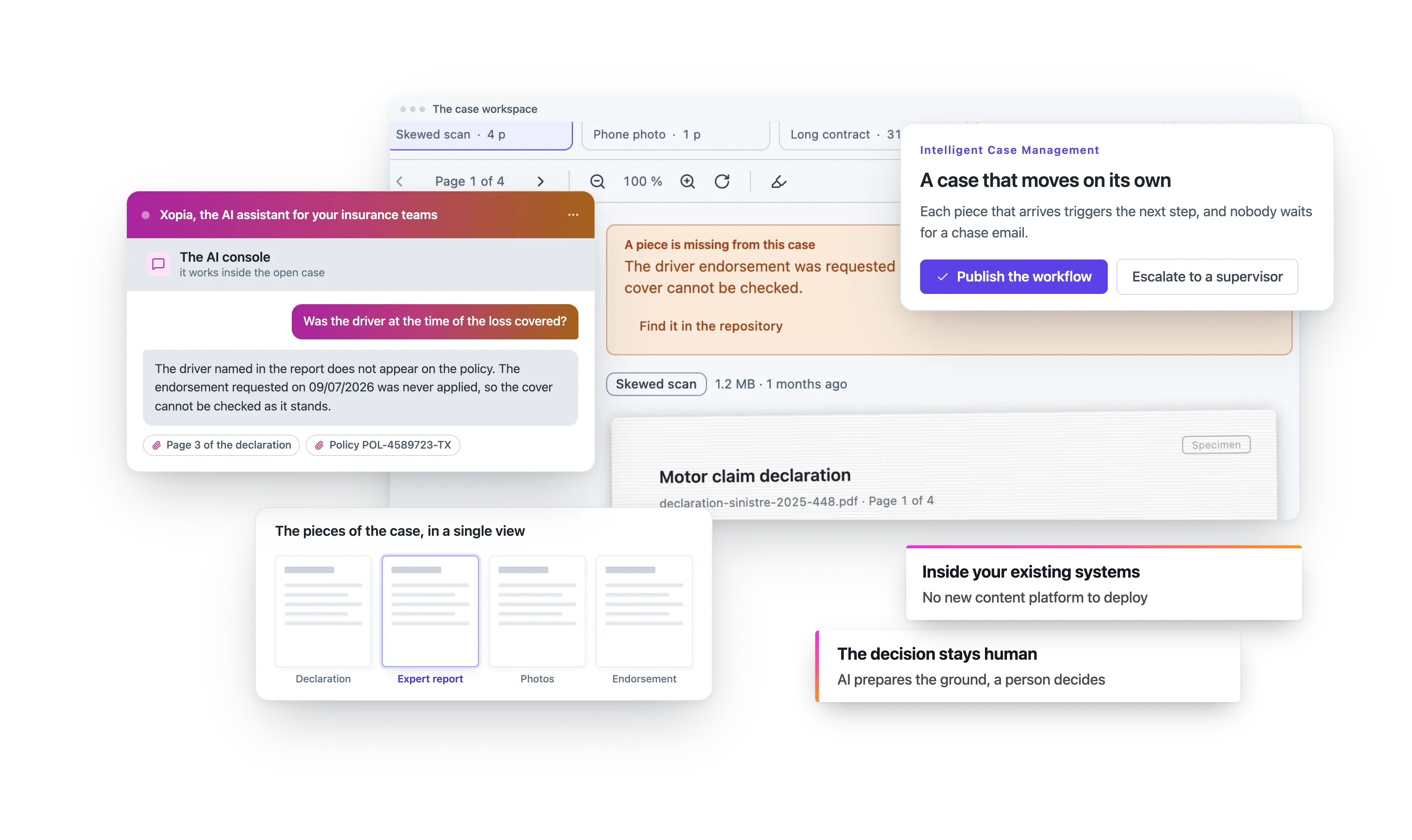
Insurers do not lack data. They lack information they can act on.
The challenge is to make that information usable, governed and contextualized inside the systems that already run your business.

- Claims adjusters spend too much time searching for information instead of reviewing cases.
- Underwriters have to reconstruct the context behind a submission before they can make a decision.
- Compliance teams still prepare for audits as separate, time-consuming projects.
- AI initiatives run into content that is poorly governed, difficult to trace or impossible to place in the right business context.
Every day, your teams work with thousands of documents

Four challenges. One underlying problem.
- Modernize without replacing what already works Your content estate contains years of business rules, integrations and compliance history. Replacing it creates risk. Leaving it untouched creates another kind of risk. Uxopian Software helps you modernize your content environment progressively, without a disruptive replatforming project, without interrupting operations and without forcing you to replace the applications your teams already use.
- Put AI to work in the real world Uxopian Software connects LLMs to governed enterprise content so that AI outputs can be traced to their sources, reviewed and audited. Uxopian Software turns fragmented content into information teams can use to make decisions.
- Make complex insurance cases easier to manage A claim is not simply a collection of documents. It is the context behind a decision. Photographs, policies, correspondence, expert reports, legal documents, historical records and business data need to be brought together, compared and understood without forcing users to work across an ever-growing number of screens.
- Keep control as AI moves into operations Insurance AI has to operate within the regulatory and governance frameworks that already apply to the business.
AI creates value when it works
Four conditions, and none of them is negotiable at deployment time.
With the right documents
The pieces that matter in the case, not the whole repository.
With the right business context
The history, the endorsements and the exchanges behind the decision.
Under the right access controls
The permissions of your information system apply to AI as well.
With full traceability
Every output carries the content that produced it.
Keep control as AI moves into operations
Depending on where you operate, that includes requirements and supervisory expectations around model risk, consumer protection, data privacy and AI governance in the United States, the United Kingdom and Canada, as well as GDPR, DORA and the EU AI Act in the European Union.
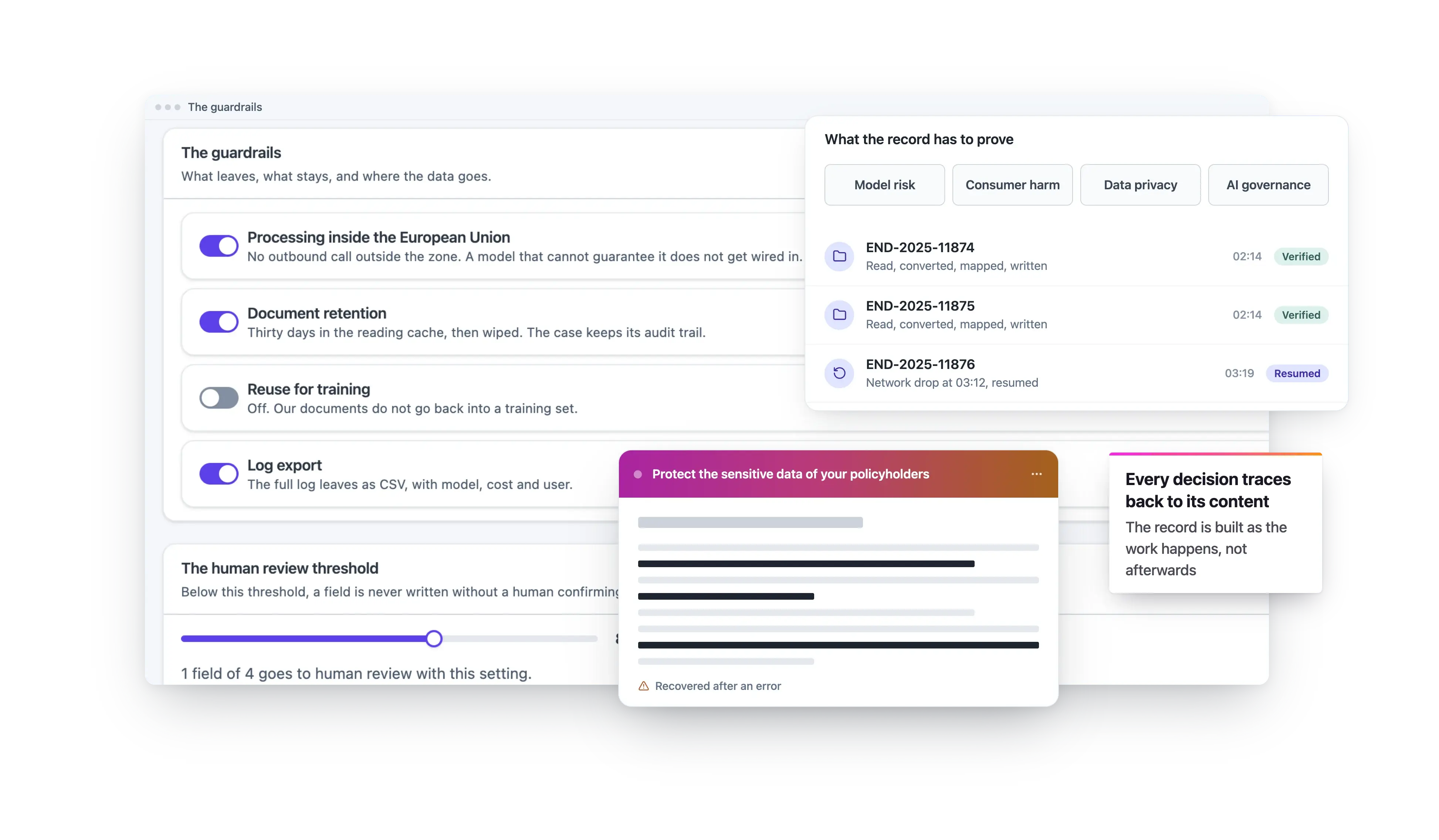
The frameworks differ by market. The underlying requirement is consistent: insurers need to know what information AI systems use, how outputs are produced, who reviews them and how they contribute to claims, underwriting and servicing decisions.
Innovation creates operational value only when it remains governable. AI-assisted decisions need to remain traceable to the source content, business rules and human validations behind them.
One content foundation. Four critical insurance workflows.
The same content, the same permissions, the same record. What changes is the work it serves.
Claims management
Reduce processing time without compromising the quality of decisions. Claims adjusters can access the documents they need, view them regardless of format, identify inconsistencies and use AI to support their analysis without removing human judgment from the process. The result is less time spent finding and checking information, and more time available to assess the claim itself.
Underwriting
Make decisions faster while preserving the evidence behind them. Underwriting files can be consolidated automatically, policies and supporting documents compared, and summaries generated from governed content. The information behind each AI-assisted recommendation remains available for review and validation.
Compliance
Move from periodic audit preparation to continuous traceability. Access logs, human validations, document versions and AI-generated outputs can become part of an audit-ready record. Instead of reconstructing what happened after the fact, teams retain the information needed to explain how a process or decision was handled.
Content modernization
Modernize your content estate without interrupting the business. Content can move progressively between systems while metadata and permissions are preserved or enriched and existing applications continue to operate throughout the transition. Modernization becomes a controlled transition rather than a Big Bang migration.
Our products do not replace your core applications. They extend what those applications can do.
Each technology addresses a different part of the problem. They can be deployed independently or combined around the systems and workflows you already have.
Your need on one side, the technology that answers it on the other. One product is often enough to start.

Three decision-makers. The same information.
Modernize without rebuilding. Bring AI into existing systems without creating another layer of technical debt or forcing a full rip-and-replace program.
Build the evidence as work happens instead of reconstructing it later. Keep source documents, access controls, AI outputs and human validation connected so that processes remain traceable, reviewable and defensible.
Make faster decisions with information that is finally brought together and put into context, without searching across multiple repositories and applications.
Why leading insurers choose Uxopian Software
Large insurance organizations choose Uxopian Software when they need to:
The content stays in the systems that hold it. AI comes to the content, never the other way round.
Documents, permissions and audit trails stay inside your environment, under your own rules.
One perimeter at a time, without interrupting operations and without touching the applications in place.
The pieces that matter arrive together, readable and compared, instead of being gathered by hand.
The evidence builds up in the daily work rather than in a parallel audit project. Our customers are evidence that this approach works in the complex, business-critical environments it was designed for.
The vocabulary your cases put at stake
Insurance is entering a new phase of AI adoption
What happens today
AI can create value. This debate is over.
What changes
The question is whether that value can be delivered, explained and governed in environments where decisions carry regulatory, financial and customer consequences.
At Uxopian Software, we believe this transformation does not require insurers to replace the systems they already depend on. It requires them to make better use of the content, cases and document workflows already inside those systems.

That is how AI moves from experiment to operational capability
Bring the pieces, the data and the tasks of a claim together, and follow every decision.
Explore intelligent case managementPut AI to work inside the applications already in place, with no new content platform.
Explore AI-powered modernizationView, compare and annotate every piece of the case, whatever its format.
Explore intelligent viewingModernize your content repositories progressively, without interrupting the business.
Explore ECM migrationWhere to start
Start with the process that costs you the most today: a claim, a submission, an audit. The rest follows.
Your questions about AI and document management in insurance
How can insurers use AI without replacing their document systems?
By connecting AI to the content you already have, where it already lives. Documents keep their access rights, metadata and business context, and AI comes to them.
You roll out new use cases one at a time, with no replatforming of your content. The approach is detailed in AI app modernization.
How can insurers make their documents AI-ready?
Policies, endorsements, expert reports, letters, emails, supporting documents, photos, claims history: you already have the material. For AI to use it, each document must be findable, linked to the right case and read under the right permissions.
Uxopian Software connects AI models to this governed content. Every answer carries the documents that produced it, so it can be checked. When content lacks metadata, content governance puts it back in order.
How does AI improve claims management?
It helps claims handlers find the right documents, summarize a case, compare documents and spot inconsistencies. It is only as useful as the context it sees: the policy, the photos, the expert reports and the exchanges with the policyholder.
The case brings all of this into one decision space, and AI supports the analysis while the handler keeps the decision. That is what intelligent case management is about.
How can you automatically process the documents of a claim notification?
Documents arrive by email, portal, scanner or partner application. On arrival, AI recognizes each document's type, links it to the right case, extracts the useful data and gives the suggested handling a confidence level.
Simple cases move on by themselves, ambiguous ones go to human review. The details are on the intelligent document capture page.
How can insurers make AI outputs traceable and auditable?
By keeping the link between each answer and what produced it: source documents, their versions, the access rights applied, the approvals and the business context.
This trail is built when the document is viewed, annotated, summarized or added to the case. Nothing has to be rebuilt after the fact, and your results stay explainable, verifiable and auditable.
How can insurers combine AI with DORA, the AI Act and GDPR compliance?
With a governed document architecture. You keep control of access, versions, approvals and the sources AI uses, and the logs stay available for internal control and audits.
Compliance shifts from one-off audit preparation to permanent traceability. The full framework is described in content governance.
Can insurers modernize a legacy ECM without disrupting business applications?
Yes. Content migrates in batches, metadata is enriched along the way, and business applications keep running throughout the transition.
Your teams face no disruption, and each batch is checked before the next. The method is on the ECM migration page.
Which Uxopian Software solutions support insurers' document needs?
Each need has its solution: intelligent case management for claims and underwriting, intelligent document capture for incoming documents, the universal viewer to open any format, and ECM migration and content governance for legacy content.
They run on four technologies: Content Operations, Repository and Workflows, Rendition and Collaboration, and Artificial Intelligence. Use them separately or together: see the Technology page.