Industries/Banking and financial services
Banking and Financial Services: Put AI to work in your existing systems
Without losing control of your content, cases or compliance. AI does not transform a bank simply because it can produce answers faster.
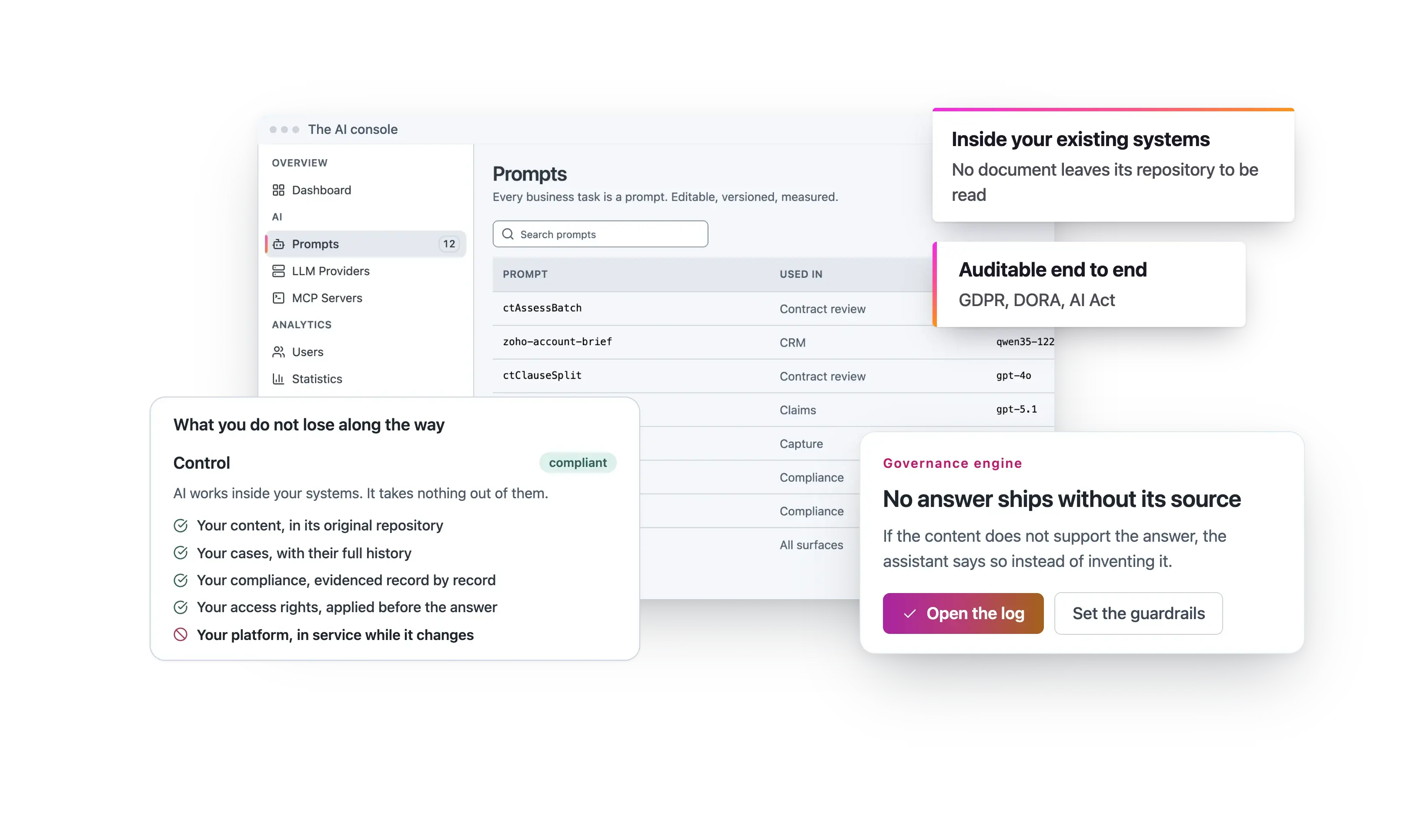
Banks do not lack data, they lack context

The information already exists but it is often distributed across different applications, content repositories and generations of information systems.
Employees therefore spend a significant part of their time finding documents, checking information and reconstructing the context of a case before they can even begin to make a decision.
AI does not solve that problem if it remains disconnected from the content, permissions and business rules that give the information its meaning.
What a banking decision actually depends on
Every banking decision depends on information contained across multiple documents and systems:
Eight families of records, and as many places where they live. The case is never whole in one of them.

Banks do not have one AI challenge, they have four operational challenges
It creates operational value when it can work with the right content, in the right context, with full traceability, without forcing you to replace the systems your business already depends on.
- Modernize without replacing critical systems Systems that carry critical processes, and that can be neither stopped nor left to age.
- Put AI to work with real banking context Versions, permissions and business rules the model has to account for before it answers.
- Bring complex cases together A loan, a KYC file, a fraud investigation: dozens of documents to gather before a decision.
- Keep control as AI moves into banking operations Supervisors in every market ask the same question, in different words.
Modernize without replacing critical systems
What happens today
Banking systems can remain in operation for decades. Many support processes that cannot simply be interrupted.
What changes
Uxopian Software helps banks modernize their content environments progressively, without disruptive replatforming, without unnecessary downtime and without giving up the governance already built into critical systems.
Replacing them creates risk. Allowing them to become harder to maintain and evolve creates another.
Put AI to work with real banking context
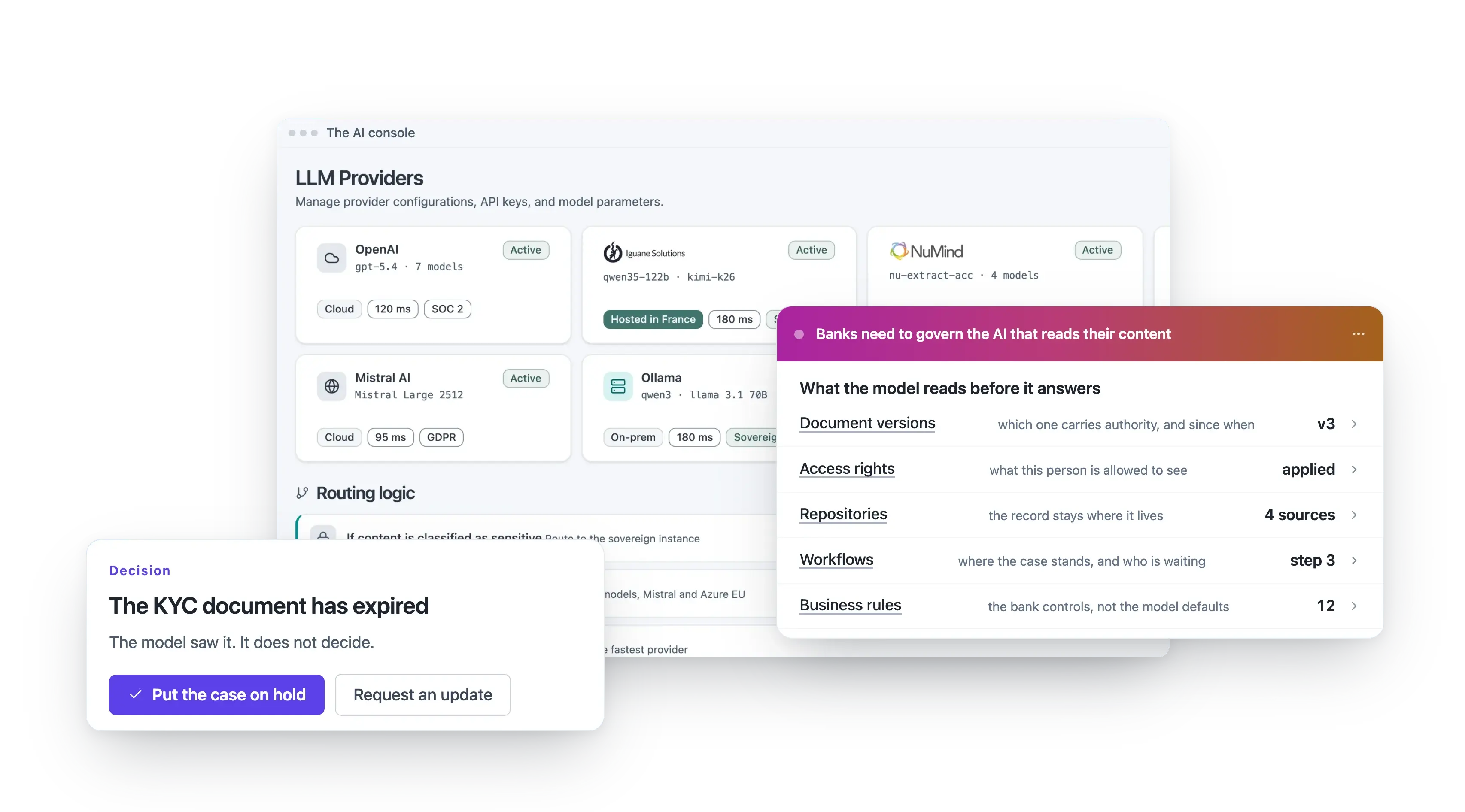
AI cannot produce reliable business support from information stripped of its context. It needs to account for:
- document versions; Which one carries authority, and since when.
- access rights; What this person is allowed to see, applied before the answer.
- repositories; The record stays where it lives, it is not copied out.
Uxopian Software enables AI models to work with governed enterprise content so that outputs remain connected to the information and rules behind them.
- workflows; Where the case stands, and who is waiting on what.
- business rules. Teams can review the sources, validate the result and retain the evidence required for audit and compliance.
Bring complex cases together
Whether it is about a loan application, a KYC file, a fraud investigation or a compliance case, each may depend on dozens or hundreds of documents, records and interactions. When that information is fragmented across systems, processing takes longer and important context becomes easier to miss.
A loan application
The applicant's records, the analysis, the guarantees and the decision, in one place.
A KYC file
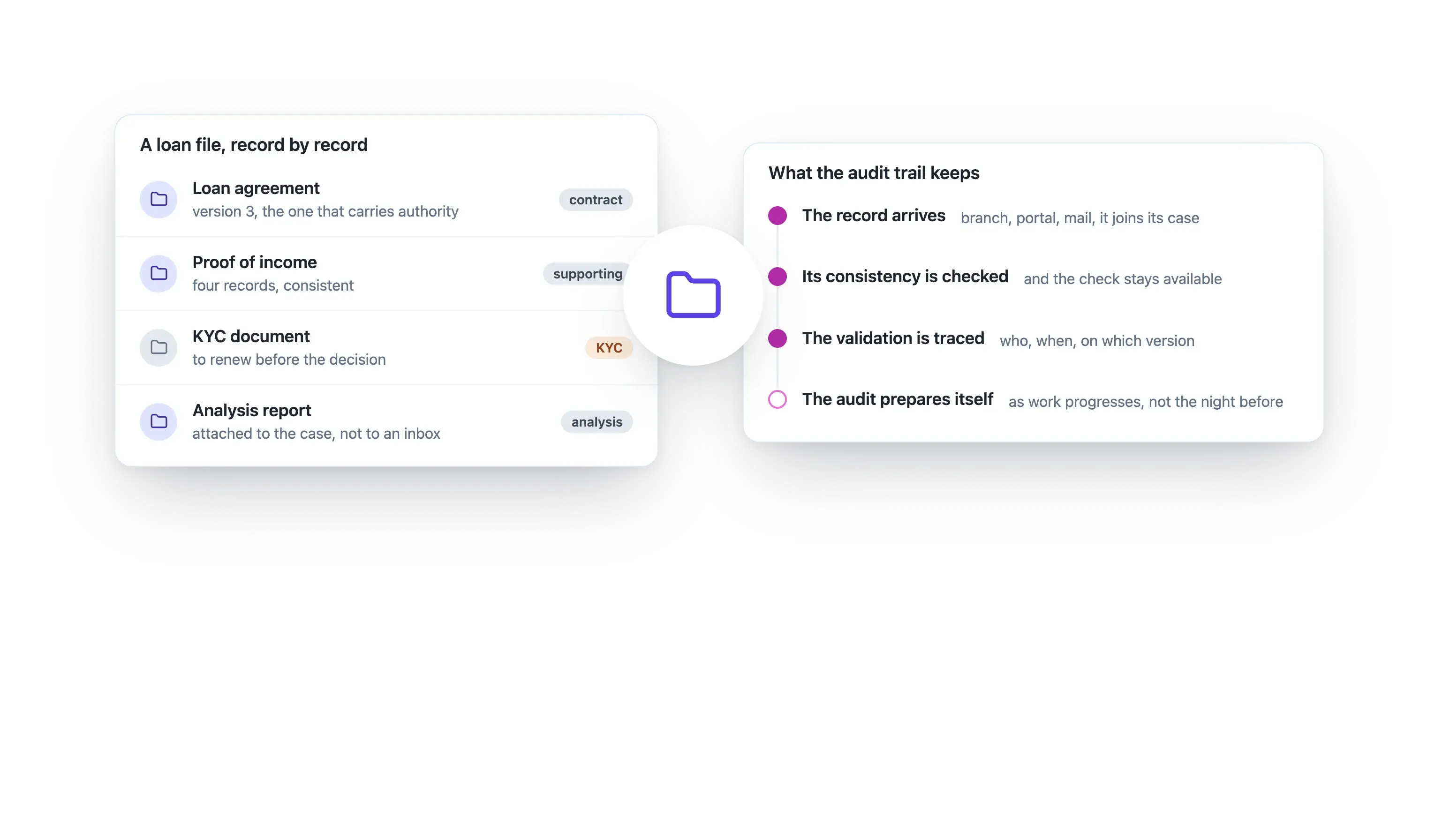
Identity evidence, its consistency, and the trace of every validation.

A fraud investigation
The exchanges, the anomalies found and what triggered the alert.
A compliance case
The regulatory records, the version in force and the proof it was applied.
Uxopian Software brings the relevant content together around the case, instead of making users navigate more applications to reconstruct it.
Keep control as AI moves into banking operations
Banking AI does not operate outside the rules that already govern financial institutions. Depending on where you operate, that means working within requirements and supervisory expectations such as:
- model risk management guidance from the Federal Reserve and OCC in the United States; Model inventory, validation and ongoing monitoring, documented.
- PRA model risk management principles and FCA governance expectations in the United Kingdom; Accountable owners, and evidence that the model is understood.
- OSFI model risk management requirements in Canada; Proportionate controls, reviewed as the use of the model changes.
- GDPR, DORA and the EU AI Act in the European Union; Personal data, operational resilience and classified AI use, together.
- internal risk, audit and governance frameworks across every market. Your own rules come before any tool's, not the other way round.
The objective is to deploy AI your organization can govern, review and defend.

The frameworks differ, the requirement does not
Know what the AI uses
The regulatory frameworks differ. The operational requirement is remarkably consistent: banks need to know what their AI systems use, how outputs are produced, who reviews them and how those outputs affect business decisions.
Keep the chain connected
That means keeping source documents, permissions, business rules, AI outputs and human validation connected throughout the workflow.
Deploy what you can defend
Nothing here asks for less AI. It asks for AI whose answers can be traced back to the records and rules that produced them.
Critical banking workflows depend on content
- Lending Bring the information behind a credit decision together. Collect the required documentation. Put information into context. Accelerate review. Preserve the evidence and validation behind each decision. AI can help teams identify, compare and summarize relevant information without separating the analysis from the documents on which it depends.
- KYC and compliance Make document-intensive controls easier to manage and easier to audit. Consolidate supporting documents. Check information for consistency. Track validations. Maintain an audit-ready record as work progresses. Instead of rebuilding the history of a case for an audit, keep that history connected to the workflow from the start.
Four workflows, one content foundation. You instrument one, then the next.
Servicing customers, and modernizing what serves them
The same content foundation carries the work at the counter and the work behind it.
Customer servicing
Give teams the information they need without making them search across systems. Retrieve relevant documents quickly. Compare versions. View content regardless of format. Give employees the context they need to answer customer requests. Less time reconstructing the information means more time dealing with the request itself.
Content modernization
Modernize legacy content platforms without interrupting banking operations. Move and transform content progressively while branches, processing centers and back-office teams continue to work. Preserve metadata, permissions and traceability throughout the transition rather than treating them as problems to reconstruct after migration.
One content foundation, four capabilities
These technologies can work independently or together, depending on the systems you already have and the problem you need to solve.
They extend existing environments rather than requiring you to rebuild those environments around a new platform.
Why banks choose Uxopian Software
Banks and financial institutions work with Uxopian Software when they need to:
The objective is to make the content and systems already inside the bank more useful for the work that needs to happen.
Banking will not enter the AI era by replacing every system that came before it
Banks already hold much of the information AI needs: customer records, contracts, supporting documents, correspondence, case histories, business rules and years of operational knowledge.
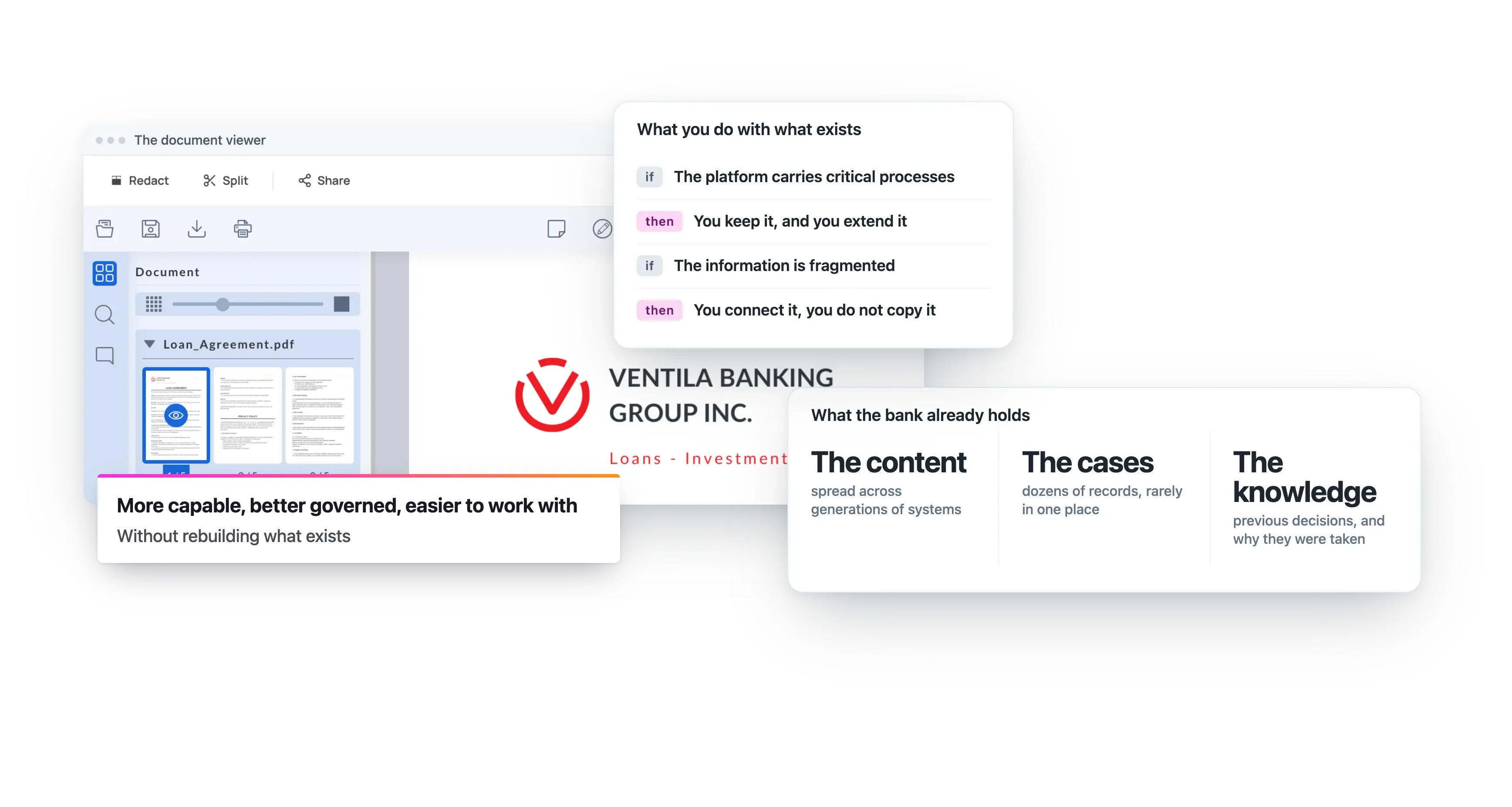
The challenge is to make that information usable by AI without separating it from the context, controls and systems that give it meaning.
At Uxopian Software, we believe lasting modernization comes from making existing systems more capable, easier to work with, better governed and ready for AI, rather than rebuilding them every time technology changes.
Six words worth agreeing on before you start
These are the terms that come back in every steering meeting, and they decide the rest.
The contracts, supporting documents, correspondence and previous decisions that surround a decision. Without them, an answer is an opinion.
Who is allowed to see which record. An AI that ignores them answers correctly and exposes the bank anyway.
Where the document actually lives. You connect to it, you do not make one more copy.
The evidence behind each decision, kept with its version and its date, and presentable to an auditor as it stands.
Content that carries its permissions, its versions and its business rules wherever a model reads it.
An output you can trace back to the records and the rules that produced it, months later.

Start from your workflow, not from a feature list
Bring the records, the data and the decisions together around the case, through to closure.
See the solutionPut AI to work inside your existing systems, without disruptive replatforming.
See the solutionView, compare and annotate any format without taking a document out of its repository.
See the solutionMove legacy content platforms forward without interrupting banking operations.
See the solutionWhere to start
Put AI to work where your content, controls and decisions already live. Tell us which content workflow slows your teams down today, lending, KYC, fraud or compliance. We will show you what it looks like on your own records.